
AREAS OF EXPERTISE
Sustainable Aviation Management focuses on three core areas:

1. SAF & LH2 Aircraft Integration Challenges
Insight into the practical integration of SAF and LH2 aircraft into commercial aviation, with a focus on the distinct operational and managerial challenges associated with each pathway.
For SAF, the focus is on cost, availability, procurement, regulatory compliance and supply-chain scalability.
For LH2 aircraft, the focus is on the operational compatibility challenges associated with new aircraft design characteristics, cryogenic refuelling requirements, additional safety procedures, larger fuel safety zones, potential restrictions on parallel turnaround activities and new ground-handling processes. Particular attention is given to the operational conditions LH2 aircraft will need to satisfy to become commercially viable, including broad compatibility with existing turnaround times, aircraft utilisation rates, crew factor targets and airport operating constraints such as night curfews.

2. LH2 Aircraft Adoption: Airline Strategy & Transition Management
Strategic and managerial analysis of how LH2 aircraft adoption may affect airline operating models, business model coherence and long-term competitive positioning.
This area focuses on the transition challenges associated with introducing LH2 aircraft into existing airline systems, including the selection of suitable sub-networks based on evolving LH2 supply availability, gradual fleet phase-in, dual-fleet management, and the organisational capabilities required to manage a prolonged technology transition.
Particular attention is given to low-cost and high-utilisation airline models, where operational simplicity, fleet commonality, short turnaround times, high aircraft utilisation and cost discipline are central to business model performance. In this context, LH2 adoption becomes not only a technology decision, but also a strategic transformation with implications for network planning, resource allocation, organisational structures, cost dynamics and business model resilience.
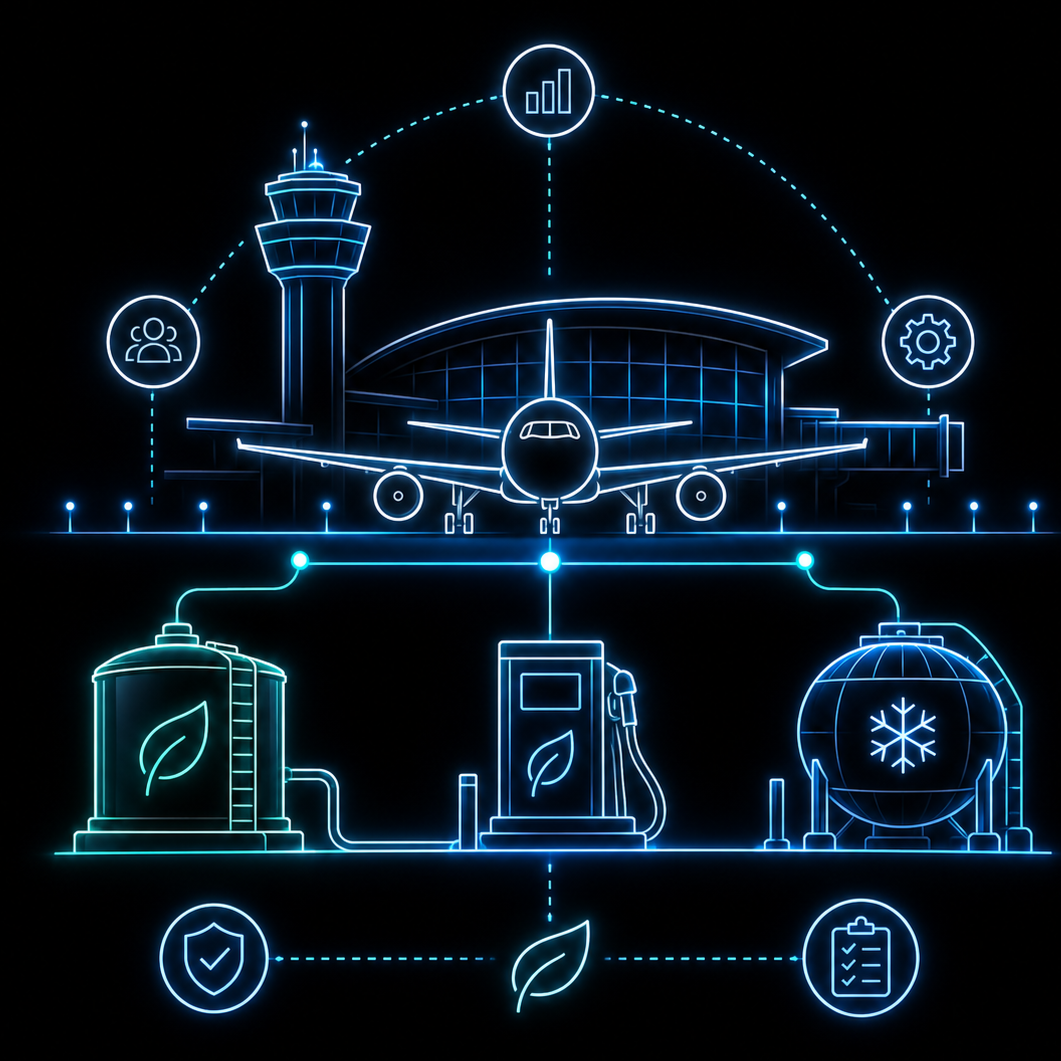
3. Airport Infrastructure & Aviation Ecosystem Readiness
Insight into the airport infrastructure and ecosystem planning required to support the coexistence of conventional jet fuel, SAF and future LH2 aircraft operations.
This area focuses on parallel infrastructure planning: maintaining and adapting existing jet fuel/SAF systems while developing dedicated LH2 storage, distribution and cryogenic refuelling infrastructure.
The objective is to support aviation stakeholders in planning the adaptation of airport infrastructure, ensuring that future infrastructural assets preserve operational flexibility and allow different aircraft and fuel technologies to coexist within the same airport ecosystem.