
STRATEGIC INSIGHTS
What the AZEA Roadmap Means for Future Hydrogen Airline Operations
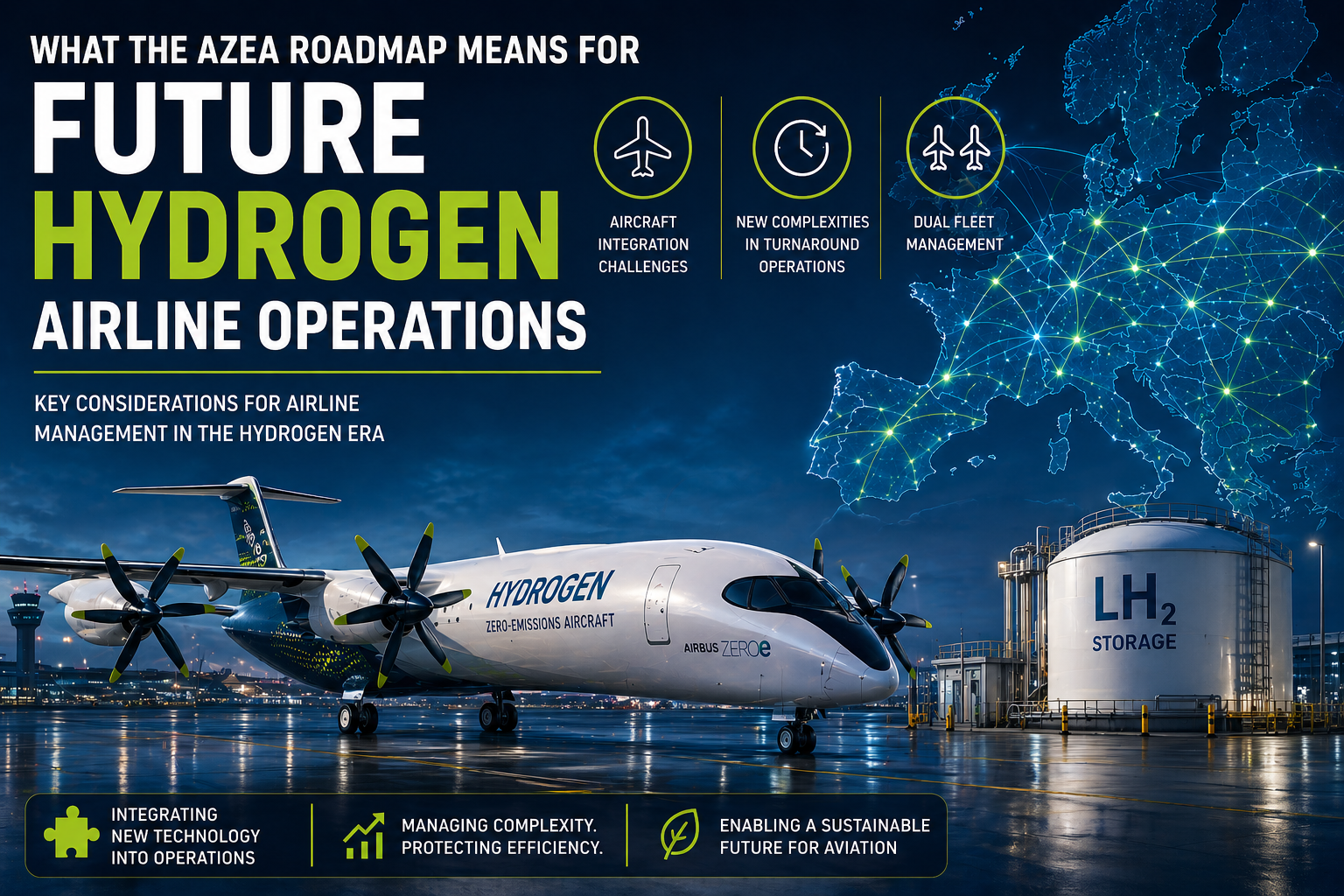
The recently published Alliance for Zero-Emission Aviation (AZEA) roadmap outlines a structured pathway for the development of hydrogen aviation in Europe.
While much of the discussion understandably focuses on infrastructure, regulation, and technology readiness, the implications for airline operations and strategy remain less explicitly addressed.
From an airline management perspective, three considerations stand out.
1. Aircraft integration challenges
The roadmap implicitly assumes that hydrogen aircraft will become available as a technological solution.
However, the issue with hydrogen is that it introduces a new range of constraints that go well beyond propulsion: new ground handling processes, airport infrastructure compatibility, and the local availability of LH2 supply all become part of a fundamentally more complex equation.
As a result, what might appear as a relatively straightforward integration of a new aircraft type into the existing fleet becomes, in practice, a broader, at least partial reconfiguration of the airline operating system, driven by the additional operational constraints and system interdependencies introduced by hydrogen.
2. New complexities in turnaround operations
One of the least discussed aspects in high-level roadmaps is the impact on turnaround operations. Hydrogen refuelling, with its associated safety procedures and operational constraints, is likely to introduce additional restrictions and complexity into the turnaround process, particularly in the early stages of the LH2 transition.
This is especially relevant for short-haul operations, which are characterised by high aircraft utilisation rates. In this context, even marginal increases in turnaround time can have disproportionate effects on operational efficiency, with direct implications for airline cost structures and financial performance.
This is a dimension that OEMs will need to consider carefully when navigating the inevitable trade-offs in LH2 aircraft design: commercial viability will depend not only on technological feasibility, but also on the extent to which new aircraft concepts remain compatible with core operational requirements.
3. Dual fleet management
Hydrogen aircraft will not be a one-to-one replacement for current narrowbody fleets.
Range limitations, uneven LH2 availability, and varying levels of airport infrastructure readiness will likely lead to asymmetric network deployment, where only part of an airline’s network will initially be compatible with LH2 operations.
This adds a further layer of complexity to the transition. Airlines will need to plan the progressive phase-in of LH2-powered aircraft into suitable sub-networks while continuing to operate conventional (jet fuel and SAF-powered) aircraft across the rest of their operations.
This will have particularly significant implications for low-cost carriers, as a key enabler of the low-cost airline model has historically been the use of a single aircraft type. The gradual introduction of LH2 aircraft into existing fleets will challenge this logic, creating new complexity ranging from the loss of crew interoperability between aircraft types to the management of more complex organisational, training, and maintenance structures (required to operate two different fleets simultaneously).
Overall, the AZEA roadmap provides a valuable macro-level framework for the transition towards hydrogen aviation.
From an airline management perspective, however, the critical challenge will not lie in the adoption of a new propulsion technology per se, but rather in its seamless integration into a highly optimised and tightly constrained operational system.